Wednesday, December 3, 2014

Holiday Decorations

Team Explore has holiday spirit.  We took some time to get our room ready for winter and the holidays.  We had some bulletin boards to switch up and needed some festive touches in our environment.

We have so many bulletin boards this year, which is great.  However we felt a bit stuck on what to put on all them.  We have the basics, math word wall, word wall, inquiry board, etc.  Then there were 2 with work from the beginning if the year still.  Yikes!  One is a reflection calendar, we will save that for a later date.  Then I thought the other could be a seasonal or themed one that was more 'just for fun' board.  Students decorated gingerbread cookies for a fun holiday bulletin board in our room.  They had such a great time getting to color with their peers.  It is always nice to have some down time to enjoy each other's company.


We also made our snowman addition projects.  Students picked two number cards at random.  The numbers were matched to their math group ensuring they were adding numbers that were right for them.  They had one number has white snowflakes, and then the other number was blue snowflakes.  They filled in a sheet to say how many of each were falling on the snowman and wrote a number sentence to match.  It was a great activity and painting with hands is always exciting!  We did get this idea from Pinterest.  We created our own templates and writing portion after researching some winter math crafts.  


Monday, December 1, 2014

Math Fact Turkeys

Last week had only 2 days of school, but I feel like I saw so much turkey stuff around school.  I wanted to create a math project that would be fun, Thanksgiving themed and differentiated.  After looking around online and talking with my teaching partner I decided turkeys were the way to go.  We currently have 4 math groups so we needed 4 ways to mix math and turkeys.  One group is working on adding 1 to a number, the next is doing strategies to add any 2 numbers, we have one group learning doubles plus one and then a group learning how to find addition facts with a certain sum.  We decided the first 3 groups would use 2 different colored feathers to represent the addends in the addition fact, and the third would write the sum on the turkey body and the addition facts that equal that number on all the feathers.

After deciding how we would go about doing this project is was time to ready all the materials and start our work.  We made a white card stock copy of the body for them to cut and color. We copied feather outlines on orange, yellow, red and purple to give options and keep it fall themed.  We really wanted to use construction paper, so being brave we tested it in the copier and it worked.  Amazing!  The next day we did the first half of the project.  Each group met 1 at a time with the teacher their group had been working with you see what they needed to do.  They spent their workshop time only making their turkey.  They colored a body and cut it out.  Then cut out feathers in 2 colors, unaware of what they would do with them.  Once everything was cut out they glued it to a large piece of black paper and went on to do typical math workshop activities.  On day 2 they got a part that we glued on to the bottom of the black paper.  This had a little problem saying how many of the 2 colored feathers the turkey had, and a place to write a matching addition sentence.

The students really enjoyed doing this. It was a great way to integrate art, math and holidays.  Keep a watch on the blog... Our snowman version will be posted soon too!

Here are examples of our work!

This shows a number plus 1.  They got 1 feather of a color they choose then cut out however many or the other color they wanted.


This shows the group that just added 2 numbers.  Unfortunately I did not get a photo of the doubles plus 1 group.  Theirs looked like this but they did a math fact such as 6+7 to practice finding a double and adding 1 more.


This is the group that wrote number sentences with the same sum.


Wednesday, November 12, 2014

Flipped Lessons

Lately I am really into flipped lessons.  I liked building my background knowledge before attending seminars as a learner, but for some reason I never thought to do this for the learners in Team Explore.  

We are fortunate enough to have some great media resources in our school, Discovery Education being a personal favorite, that make flipped lessons possible.  I am also lucky enough to get to work with a great staff that would talk about flipped lessons and keep it buzzing in my ear.  

A couple weeks ago I decided to go for it after teaching our class how to login into Discovery Ed and access their assignments with our technology integrator.  I picked a math group that I knew would enjoy it, and also be able to login independently.  This group had been learning new strategies to solve addition problems and was going to start learning about ways to make ten.  They were assigned a fun Math Monster video about making groups of ten.  In their math pocket they were given a sheet to record the many ways to make ten while they watched.  Students were watching, pausing, recording ideas, playing it again, etc. so naturally that it blew my mind.  After they watched and recorded all of their ideas/findings they were free to transition to workshop.  The following day they came to their first seminar on making ten with more background knowledge and a better understanding.  I received many comments on how they liked using videos and think sheets to get some information before attending a seminar to learn it from me.  We have done this a couple more times since then in math.  The students are able to gain insight and new information before diving into problem solving and discussions with their seminar group.  They seem more confident and comfortable then when faced with challenges in a group of their peers.  

I would definitely recommend flipped lessons in your learning environment.  

Monday, November 10, 2014

Personalized Learning Plans

At school we use Personalized Learning Plans or PLPs to guide the students learning during their workshop time.  A group of students, to individuals can all have similar plans; depending on the needs of our class.  Over time students will have a reading, writing and math PLP to have by their side during each block of time.  Students start to use these when we sit fit as professional educators.  For example, at this point in time 1 math group of 7 students, 1 writing group of 12 students and a few reading groups of 14 students have a PLP to focus their workshop time.  By the end of the year each student will have a PLP for reading, writing and math. 

My rule of thumb is that the PLP activities should take up about 75% of their workshop time.  We are not always able to put some of our digital platforms such as Lexia and Dreambox onto their plans, and do not want these components left out.  

The form we that is used in Team Explore is a district created form that is used in grades K through 12.  There is a place for essential questions and the standards being addressed at the top.  This part is really meant for the adults that will be working with the child to guide their instruction and interactions throughout the time of each PLP.  There is then a table with a place for the main goal/focus of the unit, and a place for the student to choose how they will demonstrate that.  Below is a second table with a spot for specific learning targets and corresponding activities the student has selected to do during workshop to 'practice' each target.  If there are activities that are very specific to a learning target I will use a color coding system to show which activities will help each target.  Then at the bottom there is a place for students to self assess their work for the unit.  

At the start of a unit we sit with a group of students or individuals, depending on who will be working with the PLP goals, to fill it out.  Students are prompted to find apps, activities and games to do throughout the day to move towards their goal.  They also discuss ways they could demonstrate their learning.  These include, but are not limited to, Scribble Press Books, creating a video on iMovie, making a poster, recording them doing a task, and taking photographs of their work.  Once a PLP is written each student receives their own copy of it to keep in a designated place.  The places are different for each content area, depending on how materials are stored.  Then during their workshop time they have their personal form at an arm's reach and refer to it as needed.  As they begin to show proficiency and the unit is coming to an end students independently create their evidence of learning and this is assessed by the teacher.  This cycle starts over at the start of the next unit.

Here is a sample PLP for students who are working on sight/snap words during reading workshop 
to grow as a reader.  


Here is a math PLP for a group of students working on addition strategies.  The 'demonstrate learning' box was left empty, because in this situation students wrote in the way they would provide evidence of learning.  Their selections were to make a video of themselves solving 5 problems and taking photographs of their work/thinking for 5 problems.  On this PLP you can also see the color system mentioned above.


Saturday, October 25, 2014

Seminar-Workshop Model


In a seminar-workshop schedule students are invited to seminars that meet their needs.  In their seminar a teacher leads them through a lesson depending on content area and other needs.  In reading it might be a small group guided reading lesson or large group comprehension lesson.  In math it could be problem solving or learning a new algorithm, strategy, etc.  In writing you might lead a large group lesson or pull a smaller group to focus on a specific strategy.  While students are not in seminar, they are in workshop.  During this time they work on personalized tasks.  Students might be working through our reading or math digital platforms on their iPads, using various iPad Apps, play a hands-on game, reading or writing independently, etc.  As our students become more adjusted to this structure they use their Personalized Learning Plan (PLP) in each subject area to guide their choices.  On their PLP they can find their target for the unit, learning targets, the final project they choose for demonstrating their learning and also what classroom activities they have selected to meet each learning target.  

We started using a seminar-workshop model around March of last school year.  After attending a Professional Development session I started thinking about how we could create this structure in a room of young learners.  I took some ideas from the presenter on having groups named things corresponding to the topic, such as our shape groups for math.  Then I started thinking of ways to schedule it and share the schedule with our students.  One teaching presenting discussed how they use the calendar on their iPads to send invitations to students.  While this sounded like a great idea, I thought it might not be as efficient with our age group.  We kept on thinking... 

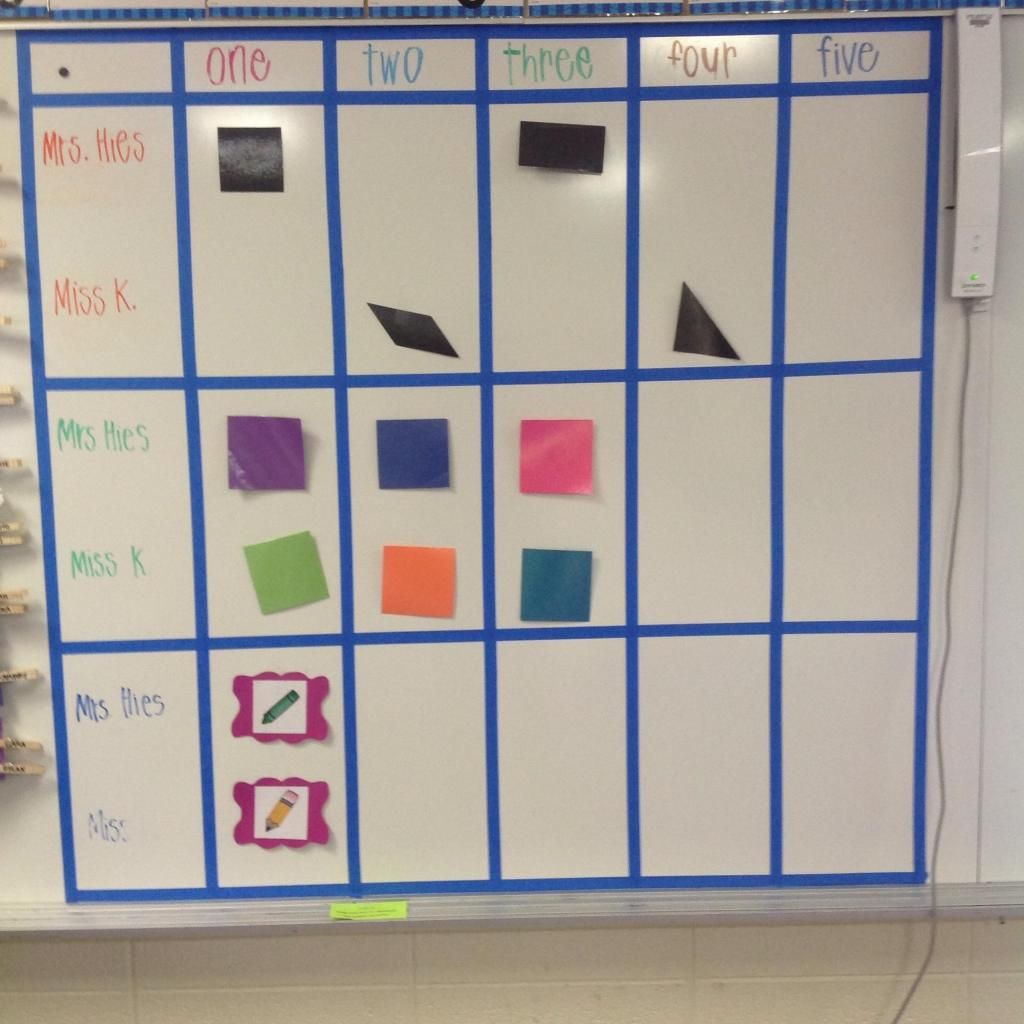
After we got back to our environment we looked at this small, blank chalkboard our old space had in it.  Using painter's tape we created a 5x2 grid.  The 5 boxes going across were labeled with numbers and the 2 sections going down were for math and reading.  We created little cards to match the names of each group and put them under one of the 5 time slots.  Their group also goes next to the teacher that will be leading their seminar.  We always start in session 1.  Then after the seminar wind chimes cue the students to freeze and we call the group for session 2 to the seminar area 

This year we had a few minor changes with our new and improved environment, along with us evolving as educators.  We have 2 seminar areas rather than one with different technology tools in each area.  We have Apple TV in one location and our Mimio Board at the other in our space.  This allows us to use different things if there ever are 2 seminars happening simultaneously.  We also added a third content section on the schedule chart to include writing; last year we did not do different seminars for writing.

I will upload an example of a PLP and also a picture of our seminar schedule board soon!

Thursday, October 23, 2014

Welcome to Team Explore!

Team Explore is a kindergarten and first grade next generation learning community at Hoover School.  We are made up of 31 students and 2 teachers.  This is our second year as a community, but our first year in our current environment.  We share 2 classrooms that are connected with a doorway;  a doorway that never shuts that is.  Students are free to move throughout the environment as they see fit for learning.  We have 2 seminar areas for teachers to lead lessons, 2 small bean tables to pull small groups and then a variety of work spaces from traditional tables to pillows on a carpet for students to choose from during workshop.  Seminar, workshop... That's our lingo.  We run a seminar-workshop model throughout our day in reading, writing and math.  Seminars are when students are in a group lesson that is led by a teacher.  Workshop is when students are working on a personalized plan to reach a goal independently. Students are placed in a seminar group for each content area and only attend seminars that are 'just right' for them.  Then in workshop they work on tasks that are also 'just right' for them.  Tasks include digital platforms, paper work, iPad apps, discovery ed flipped lessons, journals and hands on games. While this seems like a lot for young learners, they are working in a personalized environment.  Everything they do is picked by them, for them.  We also break up our day with specials, brain breaks and recess.  We are a busy group that encourages collaboration, failing forward and 21st century skills.  Welcome to a teacher's inside look at Team Explore!